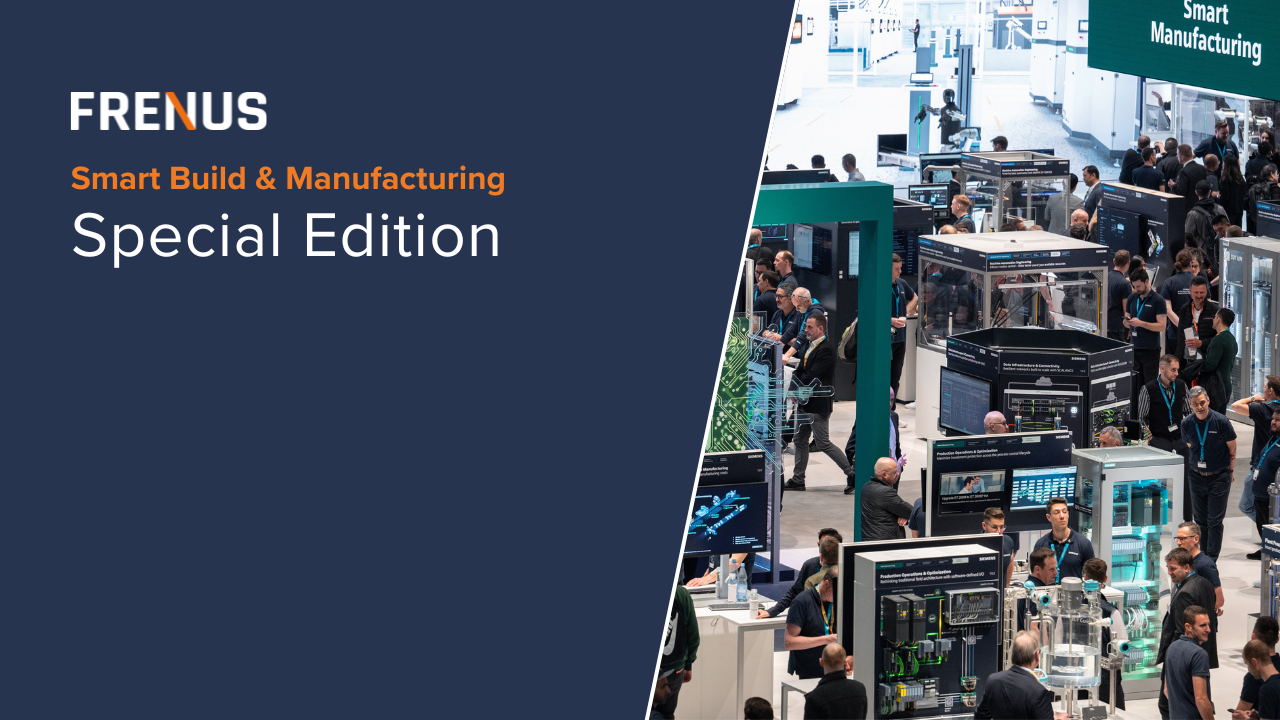

HANNOVER MESSE 2026: Industrial AI Turns into Execution, Ecosystems, and Scaled Delivery
HANNOVER MESSE showed a fair that was less about generic innovation signaling and more about execution in real industrial environments. AI remained at the center, but the stronger signals came from concrete launches, live demos, integrated data architectures, and partnerships linking software, hardware, energy, and industrial operations. A second defining thread was ecosystem building, with Brazil, Germany, Canada, and multiple regional and corporate platforms using the fair to deepen industrial cooperation.
Date
April 21, 2026

Special - Build

Methodology: Every two weeks we collect most relevant posts on LinkedIn for selected topics and create an overall summary only based on these posts. If you´re interested in the single posts behind, you can find them here: https://linktr.ee/thomasallgeyer. Have a great read!

Listen to our podcast

If you prefer listening, check out our podcast summarizing the most relevant insights from HANNOVER MESSE 2026:

Industrial AI at Scale

  • Industrial AI moved from pilot language into core operations across engineering, manufacturing, service, procurement, and plant environments
  • The strongest signal was execution relevance. AI was framed as valuable when embedded into real workflows rather than deployed as a standalone capability
  • Scale became a recurring proof point, with multiple companies showing that AI is already being used in live industrial settings rather than limited test environments
  • A more selective market tone also emerged, with success increasingly tied to data quality, process fit, and implementation discipline

Robotics & Physical AI

  • Robotics became one of the clearest proof areas, with strong visibility for humanoids, autonomous systems, AI-enabled safety, and adaptive factory environments
  • Capgemini, Tech Mahindra, Dassault Systèmes, and Siemens all linked physical AI to real industrial use cases such as autonomous action, simulation, and operational control
  • Virtual twins gained further relevance as a way to design, test, and optimize robotic systems before deployment in physical environments
  • Competitive pressure was also visible, with some signals pointing to stronger readiness and price competitiveness from Chinese humanoid vendors

Industrial Data Foundations

  • Data architecture emerged as the critical enabler behind credible industrial AI, especially where contextual process knowledge and interoperability were involved
  • Microsoft Fabric, SAP, Chem-X, CESMII, and other examples showed that connected data environments are becoming central to industrial transformation
  • The strongest solutions combined operational and business data rather than treating them as separate domains
  • Industrial data infrastructure is increasingly becoming a platform and partnership topic, not just a technical backend issue

Frontline & IT/OT Enablement

  • Hannover Messe showed a stronger shift toward worker-facing use cases, with AI being positioned to support technicians, operators, engineers, and frontline teams directly
  • ServiceNow, Capgemini, Microsoft-linked demos, and TK Elevator highlighted practical applications such as contextual assistance, shift briefings, and faster issue handling
  • IT and OT integration was repeatedly framed as essential for making industrial AI usable in daily plant and service operations
  • The broader signal was that smarter industry also depends on better support for human decision-making and execution on the ground

Energy, Hydrogen & Resilience

  • Energy transition remained a major parallel theme, with electrification, hydrogen, industrial resilience, and sustainable infrastructure strongly represented
  • Companies such as WEG, Schneider Electric, and Phoenix Contact linked energy topics closely with AI, automation, and open industrial systems
  • Hydrogen remained relevant through both association-led and regional initiatives, especially where decarbonisation and industrial competitiveness intersected
  • Battery innovation and alternative fuels added further depth, reinforcing that industrial transformation is being shaped by both digital and energy system change

Product Launches & Solutions

  • The fair produced a meaningful set of concrete solution signals, with multiple companies showcasing products and launches tied to clear operational use cases
  • LAPP, Siemens, ServiceNow, SAP, and the any.site ecosystem all presented offerings linked to robotics, engineering efficiency, maintenance, workforce coordination, or compliance
  • These launches stood out because they were technically specific and closely connected to productivity, reliability, and industrial execution
  • Compared with generic event messaging, the strongest solution signals combined clear product substance with direct relevance for plant and operations environments

Partnerships & Ecosystems

  • Partnerships played a central role, with Hannover Messe functioning as a platform for commercial, innovation, and cross-border ecosystem building
  • GRIF and DLR, Germany and Brazil, the European Investment Fund, Vulcan Energy, AWS, TimescaleDB, and Inductive Automation all contributed to this partnership-heavy pattern
  • The strongest collaborations were those that extended innovation capacity, strengthened industrial infrastructure, or supported market scaling
  • Ecosystem logic clearly mattered. Visibility at the fair was often used as a trigger for longer-term cooperation rather than as an end in itself

Brazil & Cross-Border Momentum

  • Brazil stood out as one of the most visible international themes, with strong presence across industry, startups, mining, agritech, energy, and technology cooperation
  • The country’s role extended beyond representation and into concrete collaboration on AI, startups, hydrogen, strategic materials, and industrial investment
  • Participants such as Vale, WEG, ZEISS Brazil, Mecatronic Engenharia, ACTIZ, Tecnopuc, and Robô Campo reinforced this broader capability narrative
  • The overall signal was that Brazil was positioned as a strategic industrial partner with relevance across supply chains, sustainability, and future manufacturing

Policy & Industrial Sovereignty

  • Policy visibility was unusually high, with competitiveness, sovereignty, and regulatory fit closely tied to industrial transformation discussions
  • Chancellor Merz and other signals reinforced that industrial AI is increasingly being discussed as a strategic capability rather than a narrow technology topic
  • A recurring theme was that industrial AI requires a different policy lens from consumer-facing AI because of its role in productivity, infrastructure, and manufacturing competitiveness
  • This made regulation part of the commercial story, not just an external frame around it

Subscribe to newsletter

Subscribe to receive the latest blog posts to your inbox every week.

Please confirm your GDPR consent to join our mailing list.
By subscribing you agree to with our Privacy Policy.
Thank you! Your submission has been received!
Oops! Something went wrong while submitting the form.
No items found.