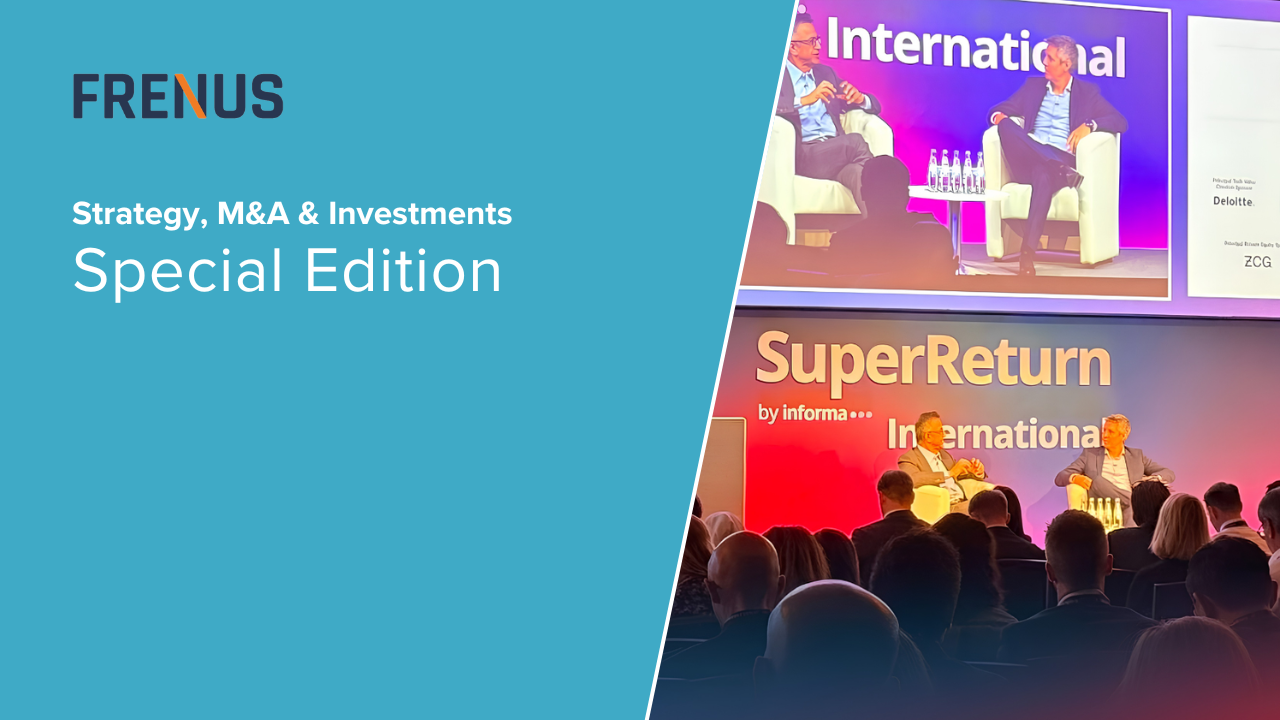

SuperReturn International 2026: Private Capital Enters the Execution Era
SuperReturn International 2026 in Berlin captured a private-capital industry moving from narrative to proof. Across the main stage, side events, booths and investor meetings, the dominant message was clear: LPs want distributions, operational value creation, disciplined underwriting and credible AI economics.
Date
June 17, 2026

Special - Strategy
Thomas Allgeyer

Methodology: Every two weeks we collect most relevant posts on LinkedIn for selected topics and create an overall summary only based on these posts. If you´re interested in the single posts behind, you can find them here: https://linktr.ee/thomasallgeyer. Have a great read!

Listen to our podcast

If you prefer listening, check out our podcast summarizing the most relevant insights from SuperReturn International 2026:

DPI Became the Industry’s Hard Currency

  • Distributions dominated the discussion
  • DPI was framed as the new benchmark for manager credibility, replacing softer narratives around paper performance
  • The market conversation pointed to a tougher reality: unsold portfolio companies, slower exits and LP fatigue with delayed liquidity
  • The strongest signal was a shift from storytelling to evidence, with investors asking for realised returns, not forward-looking explanations
  • The broader takeaway: private equity is no longer being rewarded for financial engineering alone, operational execution and cash conversion are back at the centre

The Reset is still Underway

  • Software valuations remained a major concern
  • Public commentary pointed to declining software multiples in both the US and Europe
  • The “SaaSpocalypse” debate captured the tension between reset and recovery
  • AI was positioned as a tailwind for the strongest software companies, but also as a force that separates resilient platforms from weaker assets
  • The core investment question shifted from software exposure to software quality
  • Winners are expected to be companies with durable products, defensible AI-enabled infrastructure and clear customer value

Growth meets dispersion

  • Private credit was one of the most heavily discussed asset classes
  • The tone shifted from broad enthusiasm to a more selective view of manager quality, underwriting discipline and liquidity risk
  • Several discussions framed private credit as a foundation of modern private markets, not a niche alternative
  • At the same time, dispersion, retail exposure, redemptions, software-linked credit risk and pressure points were repeatedly highlighted
  • Scale was presented as a competitive advantage, but underwriting quality remained the decisive differentiator
  • European direct lending attracted strong interest, with data centres also emerging as a relevant driver of deal activity

Operational Proof Replaces Leverage-led Returns

  • Multiple posts pointed to the end of the era where cheap leverage and multiple expansion could carry returns
  • LPs are asking for evidence of operational improvement
  • Portfolio-company execution, exit readiness and value-creation repeatability became central themes
  • The strongest managers were described as those able to demonstrate a clear, repeatable playbook
  • This creates a more demanding environment for generalist mid-market funds, which now need sharper differentiation and clearer proof points

Geopolitics, Defence and Tech Sovereignty

  • Geopolitics was treated as an investment driver, not merely a risk factor
  • Discussions linked capital flows to defence, factories, minerals, power grids and national security
  • Defence financing received dedicated attention through roundtables, NATO Innovation Fund participation and European defence-tech gatherings
  • Tech sovereignty emerged as a visible theme, connecting AI, infrastructure, energy and strategic autonomy
  • The broader implication: private capital is being pulled into areas once dominated by public policy, industrial strategy and national-security thinking

Venture, growth and regional capital

  • Venture and growth investing showed energy, but with a more sober tone
  • Access alone was no longer viewed as enough, judgement, quality filtering and founder assessment mattered more
  • AI-generated deal flow created both opportunity and noise, making selection more important
  • European venture was discussed in the context of a structural funding gap versus the US
  • Regional momentum was visible across Germany, Poland, Croatia, Latin America, Asia, the Gulf and Africa
  • The UAE was framed as a bridge for emerging-market capital, while Africa attracted dedicated investor discussions
  • The venture market message: capital is available, but selectivity has increased

Energy transition, Climate and Impact

  • Energy transition and impact were less dominant than AI or liquidity, but carried clear substance
  • Discussions focused on clean-capacity growth, energy infrastructure and the capital required to scale transition assets
  • Research shared at the event suggested transition portfolios may be more concentrated and correlated than headline fund counts imply
  • World Fund’s “Built to Scale” event and the water-investing discussions broadened the theme from climate capital to deep tech, infrastructure and resource resilience
  • Tech sovereignty, energy and infrastructure increasingly overlapped in the conference narrative

Subscribe to newsletter

Subscribe to receive the latest blog posts to your inbox every week.

Please confirm your GDPR consent to join our mailing list.
By subscribing you agree to with our Privacy Policy.
Thank you! Your submission has been received!
Oops! Something went wrong while submitting the form.
No items found.

Want to see the posts voices behind this summary?